Number, Ratio and Algebra

FROM STRONG
TO STRONGER
IN MATHS

For GCSE students aiming for the highest grades, Further Maths students, and those starting AS-level. Written for students who are already strong, and want to become stronger still.

466
pages, full colour
7
chapters across 3 parts
60+
topics, worked in depth
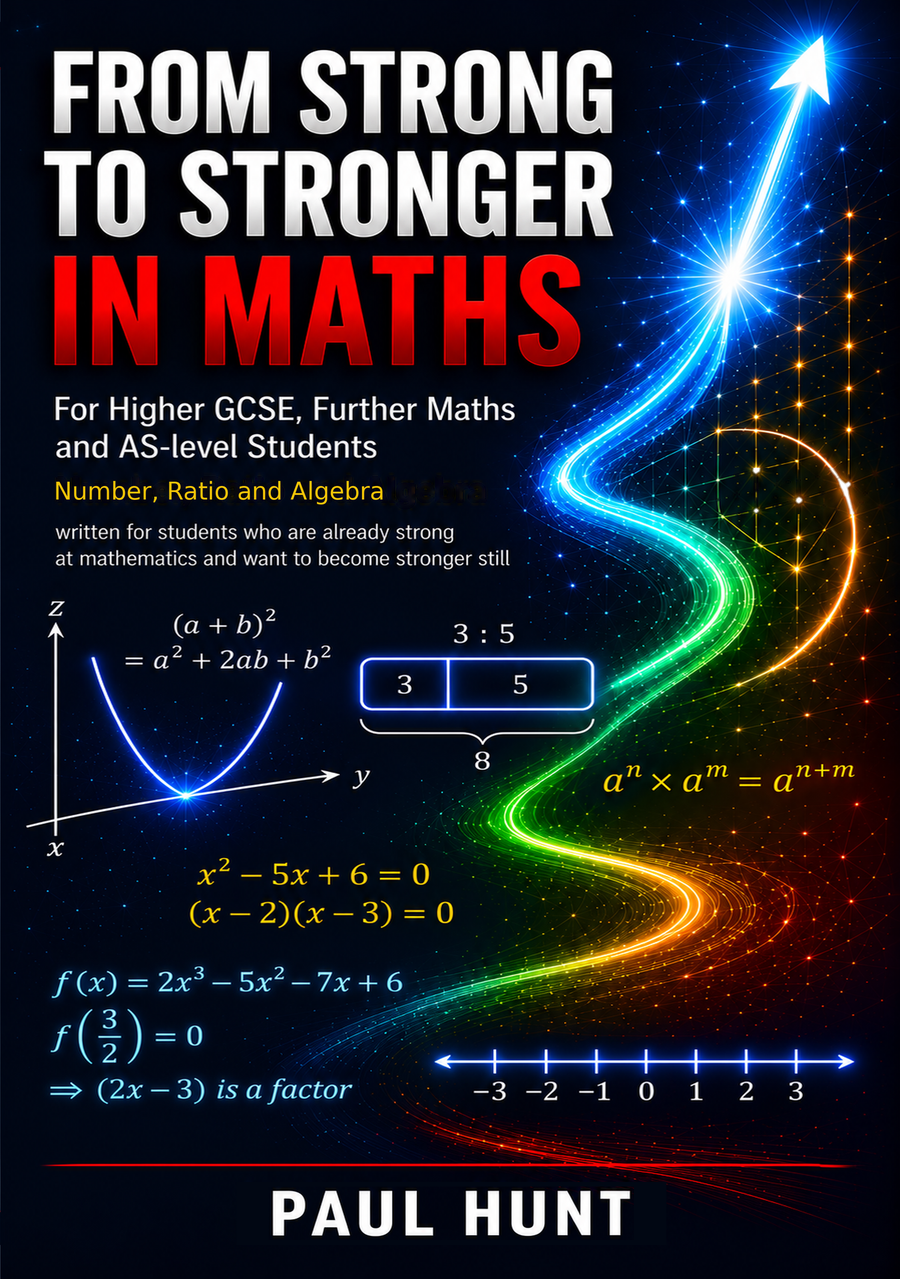
Front cover of From Strong to Stronger in Maths by Paul Hunt

Most textbooks show you one or two worked examples, then hand you fifty questions and hope for the best.

The student works through the first question or two fine, because it closely resembles what they just saw. Then they hit a question that looks noticeably different, and they're stuck. Not because they can't do maths, but because they were only ever shown one or two ways a topic could be dressed up.

This book does the opposite. Rather than a couple of worked examples propping up a huge exercise, it's built around an extensive collection of worked examples, covering as many of the situations a student is actually likely to meet. If you've genuinely seen enough variety, an exam question shouldn't be a surprise. You've met that shape of problem before, and you know how to approach it.

What's inside

The full list of topics covered, across three parts and seven chapters.

Part I — Number

1Fractions, Decimals and Percentages

  • 1.1Comparing Fractions
  • 1.2Arithmetic with Fractions
  • 1.3Mixed Numbers and Improper Fractions
  • 1.4Arithmetic with Decimals
  • 1.5Rounding with Decimal Places and Significant Figures
  • 1.6Estimating Calculations
  • 1.7Converting Between Fractions, Decimals and Percentages
  • 1.8Terminating Decimals and Recurring Decimals
  • 1.9Recurring Decimals as Fractions
  • 1.10Percentage of a Number
  • 1.11One Number as a Percentage of Another Number
  • 1.12Finding the New Amount After a Percentage Change
  • 1.13Finding the Percentage Change
  • 1.14Reverse Percentages
  • 1.15Repeated Percentage Change

2Directed Numbers and Order of Operations

  • 2.1Adding and Subtracting with Directed Numbers
  • 2.2Multiplying and Dividing with Directed Numbers
  • 2.3Order of Operations (BIDMAS)
  • 2.4Brackets Within Brackets

3The Product Rule for Counting

  • 3.1Listing Combinations
  • 3.2Making a Selection from Two or More Groups
  • 3.3Making Two or More Selections from the Same Group
  • 3.4Making Repeated Selections
  • 3.5Making Two or More Selections from Two or More Groups
  • 3.6Adding Different Possible Outcomes
  • 3.7Restricted Selections in One Group
  • 3.8Restricted Selections in Two or More Groups
Part II — Ratio and Proportion

4Ratios and Proportions

  • 4.1Simplifying Ratios
  • 4.2Linking Fractions and Ratios
  • 4.3Dividing with Ratios
  • 4.4Ratios with Differences
  • 4.5Proportion
  • 4.6Combining Ratios
  • 4.7Linking Ratios and Equations
  • 4.8Changing Ratios
  • 4.9Further Applications of Ratio
Part III — Algebra

5Indices

  • 5.1The Three Laws of Indices
  • 5.2The Zero Index
  • 5.3Reciprocals
  • 5.4Fractional Indices and Roots
  • 5.5Standard Form
  • 5.6Indices in Algebra
  • 5.7Change of Base
  • 5.8More Advanced Applications of Indices in Algebra

6Surds

  • 6.1Simplifying Surds
  • 6.2Rationalising the Denominator
  • 6.3Surds in Algebra
  • 6.4Further Applications of Surds

7Methods in Algebra

  • 7.1Expanding Brackets and Collecting Like Terms
  • 7.2Factorising Simple Algebraic Expressions
  • 7.3Solving Linear Equations
  • 7.4Solving Linear Inequalities
  • 7.5Graphical Representation of Linear Inequalities
  • 7.6Factorising Quadratic Expressions
  • 7.7Factorising Harder Algebraic Expressions
  • 7.8Completing the Square
  • 7.9Solving Quadratic Equations
  • 7.10Solving Quadratic Inequalities
  • 7.11Solving Miscellaneous Equations
  • 7.12Solving Miscellaneous Inequalities
  • 7.13Algebraic Fractions
  • 7.14The Discriminant
  • 7.15Rearranging Formulae
  • 7.16Solving Simultaneous Equations in 2 Unknowns
  • 7.17Solving Simultaneous Equations in 3 Unknowns
  • 7.18Binomial Expansions
  • 7.19The Factor Theorem
  • 7.20Algebraic Proof

Worked examples first

An extensive collection covering the situations you're actually likely to meet, not just one or two per topic.

Paul's Pointers

Small notes throughout flagging the kind of thing a teacher would actually say out loud in the room.

Nothing to distract you

A plain, uncluttered design on purpose. No competing graphics. Just the maths.

How to actually use it

Keep a piece of paper handy. Cover the solution, try the question, and slide the paper down one hint at a time.

Worked Example
x² − 5x + 6 = 0Factorise the expression
(x − 2)(x − 3) = 0Two numbers that multiply to 6, sum to −5
x = 2 or x = 3Each bracket could equal zero
Paul's Pointer: Always check your answer by substituting it back into the original equation.
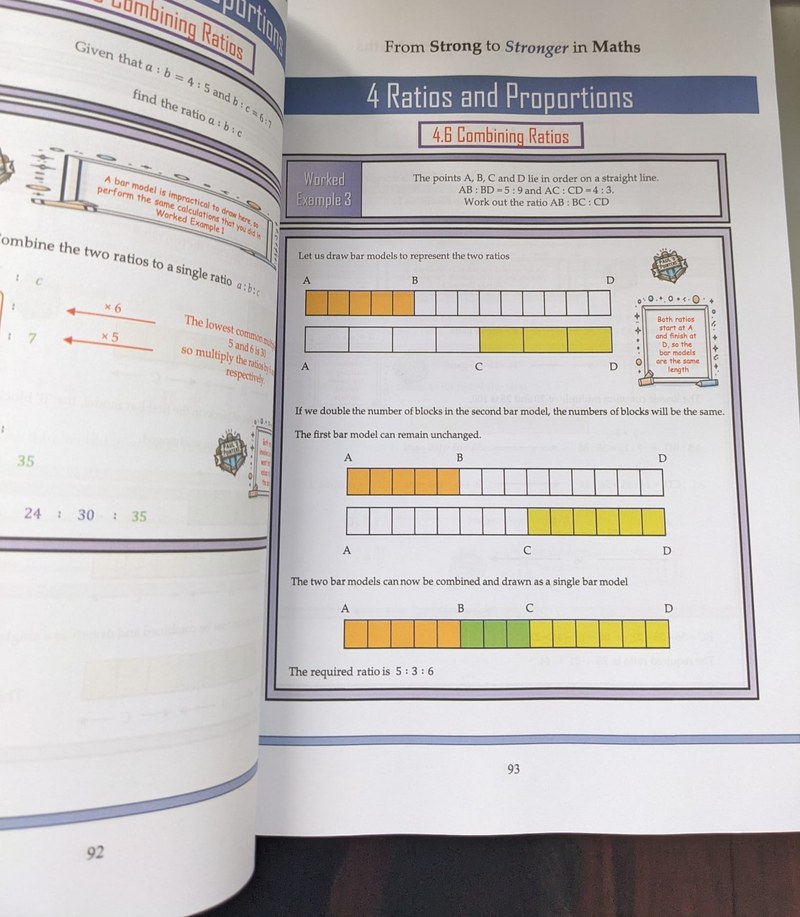
A real photograph of the printed book, open at section 4.6, Combining Ratios, showing a worked example using bar models.
A real page from the printed book — this is exactly what you'll hold in your hands.

Look inside

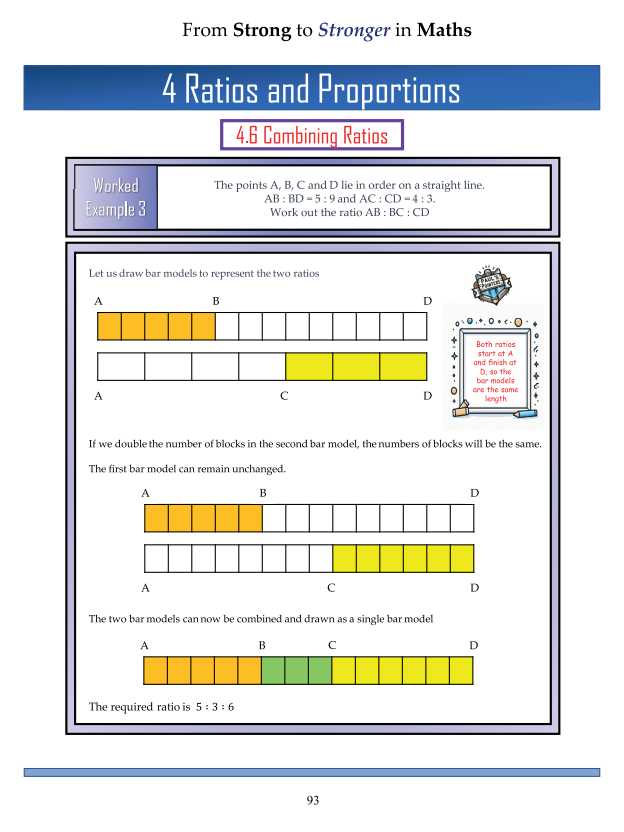
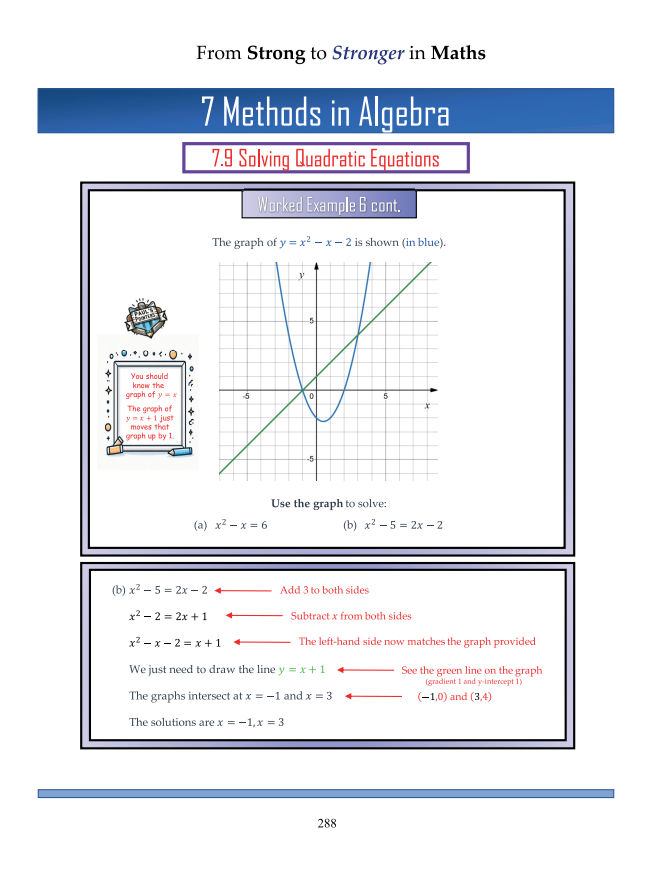
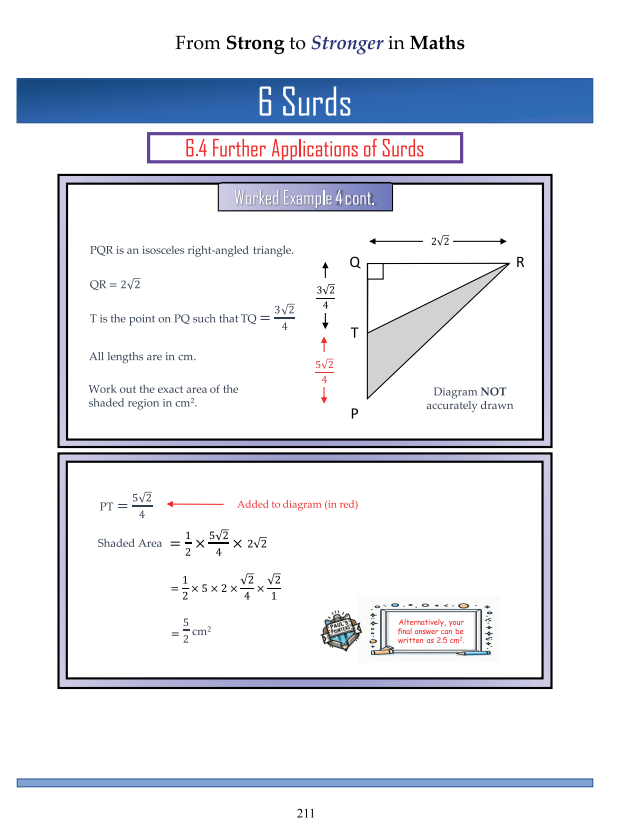
Real pages from the book. Notice how the same careful, annotated style carries across very different topics — the red arrows explain every step, and Paul's Pointers flag what a teacher would say out loud.

“Impressive… a straightforward, no-nonsense approach.”

Tom Le Bas · Maths / Educational Publisher

About the author

Paul Hunt is an experienced classroom teacher and co-author of several titles with Oxford University Press. From Strong to Stronger in Maths is self-published, written to be the book he wished he could hand every strong student who was ready to push further.

Also From Paul Hunt

Teach Further Maths

Over 3000 slides of fully animated A-Level Further Maths PowerPoint presentations.

Maths Trumps

An educational card game that makes learning maths genuinely fun. Winner of Theo Paphitis's #SBS Award.

The Global Maths Tutor

Tailored 1-to-1 online maths tutoring for KS3, GCSE and A-Level students worldwide.

Get the book

Paperback

£44.99

The complete 466-page book, full colour, A4. Printed and shipped via Lulu.

Buy the paperback

PDF

£22.99

The same 466 pages as a digital download, at half the price. Available through TES.

Buy the PDF on TES